
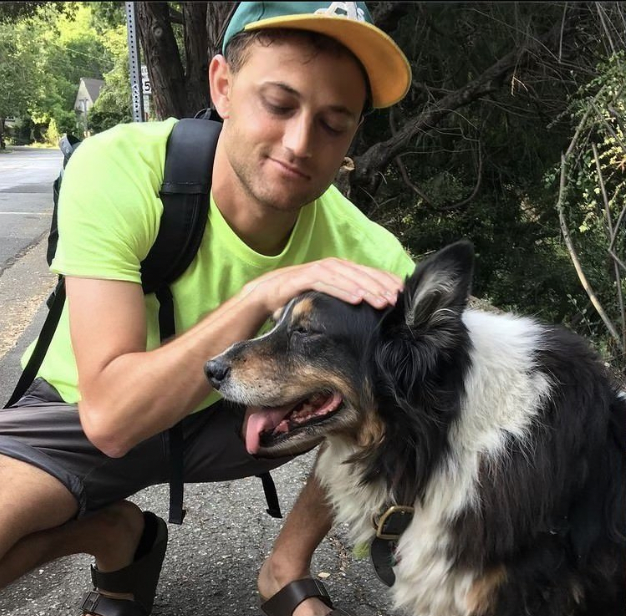
Jacob Kahn is a poet, editor, and curator living on the territory of Huichin, within the homeland of the Chochenyo-speaking Ohlone people. He is the author of Mine Eclogue (Roof Books, 2022) and the chapbook A Is For Aegis (DoubleCross Press) and cofounder, along with Sophia Dahlin, of Eyelet Press. A graduate of the University of Montana Creative Writing Department and former Missoulian, he now works as a librarian at Berkeley Public Library.
CutBank Interviews
An Interview with Jacob Kahn and Celia Easton Koehler
March 2026
Celia Easton Koehler: I’m curious about the title of this collection, Mine Eclogue — an eclogue, a pastoral poem in which shepherds converse, is polyvocal in the sense that a conversation contains at least two voices. The possessive pronoun, mine, is used to refer to things belonging to or associated with a speaker. I am curious how “mine” functions in the title as well as in the collection. It occurred to me while reading some of these poems (“deepwater horizon,” for example) that the word “mine” is also a noun and a verb— to mine is to extract a resource from ground or water (or elsewhere), a mine is a place where that “resource” came from..
Is this something that interested you while writing? The interplay between “mine” “mine” and “mine”? How do you think the “grabbyness” of the word relates to the subject matter of your book?
Jacob Kahn: This is a great question, Celia, and I’m so into your reading of the many valences the word “mine” plays throughout the collection. To be quite honest, I don’t think Mine Eclogue is that sensuous or vibrant a title—it’s rather clunky and arch, and perhaps not as catchy as I would’ve liked. Like, the first word is an archaic and stilted usage of “mine” as adjective, and the eclogue is a largely obscure poetic form (though it’s been referenced, deployed, and made contemporary by poets ever since Virgil). I try to jab at the ostentatiousness of my interest in the highbrow and arcane throughout the book, with self-deprecation, irony, punning, and this weird habit I got into of putting two question marks after all the rhetorical questions in the book. A few years before Mine Eclogue was published, I jokingly used this title for a chapbook that contained what became the spine of the book. The chapbook had a cover illustration I loved that my partner Karin Dahl drew: a hand gripping a selfie-stick, an iPhone turned width-wise in its clutches, and a swimmer, mid-stroke, in a body of water beneath mountains visible on the screen—a contemporary “eclogue” scene, if ever one was. Despite my best efforts to find a different title for the full-length, nothing stuck. The joke became the reality, and I was left holding the punchline.
I have grown fond of it, though, as it does prime the tone, content, and contradictions to come. The title calls upon other contemporary poets who’ve used, and argued with, the eclogue, like Lisa Robertson’s XEclogue and Ed Roberson’s City Eclogue. The poems in mine own eclogue (I guess that is kind of funny to me) are definitely “grabby,” to use your perfect description, and there is a frenetic, youthful energy to them that is pivotal, in my mind, to the form of eclogue (Virgil was a young poet when he wrote them, as was I), which is more an idea, an appraisal of the world, than a structuring force. Mine as explosive, mine as resource, mine as personal—this is the messy interplay of land, self, polis that I find instructive in the eclogue and that I hoped to concoct, through different mirrors and many registers, in the book.
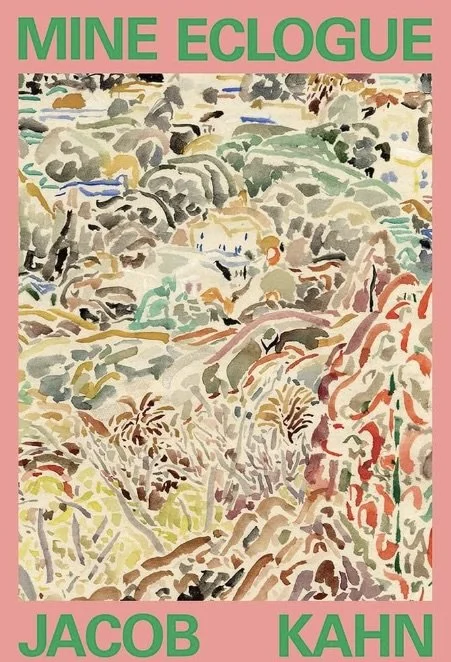
Mine Eclogue is available from Roof Books
CEK: Some of these poems are dedicated to and in conversation with other poets: Brian Blanchfield, Jean Day, Norma Cole, Alli Warren, Kevin Killian. There is a great deal of warmth and respect in the way the speaker engages being of, from, or with these companions. While I was reading and thinking about the companionship or company of other poets in the book, I went along thinking about the line in the monostich poem Solvency vs. Liquidity: “the way Love heavy line-ups open the perimeter respectably.” I am curious if you want to think at all about your own particular “love heavy line-up” and its significance to this book and to you.
JK: Mine Eclogue is a very social book, for sure, full of gossip, complaint, sidebar, dedication, elegy, inside jokes, and the general stir of sociality. (One of the consistent inside jokes throughout the book are the snatches of overheard sports talk radio language, of which “the way Love-heavy lineups open up the perimeter respectably” is an instance. That said, you’re so right to call up the other, more prescient meaning around kinship and tutelage!) Though it’s not exclusive to the Bay Area, I think this is something of a hallmark of Bay Area poetry, which can be very name-droppy and chatty. A poetics of the living room, the group chat, the confab. We love our house reading series and, like, name-dropping each other's cats. There’s a politics in these intimacies, a propulsion. Though I don’t particularly write in a New Narrative manner, I’ve been deeply influenced by this group of Bay Area writers and their legacy—the complication of genre, the mashup of high and lowbrow, the centering of gossip and community, the queering of all sorts of canons and histories. Books like mine, that write within or against another (often canonical) text, are common in this tradition. The impresario of New Narrative, Kevin Killian, for whom I wrote the elegy “Kevin, Come Back” in the book, was a great mentor to me, as he was for so many writers locally and beyond.
In terms of more formal influences, there’s a loose lineage of Bay Area lyricists that I look to and often find myself mimicking: Robert Duncan, June Jordan, Joanne Kyger, Norma Cole, Jean Day, and too many contemporaries to list because I can’t ruin my social life. But I do think the wide array of Bay Area lyric poetry is somewhat under-theorized or historicized, as I see consistent political and formal throughlines even if the poets themselves come from seemingly disparate mo(ve)ments—Berkeley/SF Renaissance, New Narrative, Beats, Gay Liberation, Black Power, Chicano Arts, Language Poetry, Occupy Poetics, and whatever blend of movements was and is going on around these.
It’s also worth mentioning that I came to the Bay Area by way of Montana, where I studied with Brian Blanchfield, who introduced me to the pastoral as a concept and living tradition. Studying at the University of Montana, I was of course influenced by writers who might be considered nature poets, like Merrill Gilfillan and Melissa Kwasny (both of whose work I adore!), and had to contend with the brutish masculinity of some of the more celebrated poets in that tradition. I guess all of this forms my own “love-heavy lineup,” opening up the perimeter, as it were. Many of these influences are named in dedications throughout the book, but almost every poem could be dedicated to someone who isn’t named.
CEK: I’m sort of amazed that “love-heavy line-up” was/is from eavesdropping sports talk. Maybe you would like to keep it on lock (respect), but where was this said and about what sport???
JK: Haha, yeah, I’ve no problem sharing my secret sports references! “The way Love-heavy lineups open the perimeter respectably” is a phrase that I probably heard on a podcast (that I was likely listening to on 1.5x speed, lol) that is in reference to a basketball player, Kevin Love, who is quite a good three-point shooter. Hence, when he plays (that is, in “Love-heavy lineups”) he “opens the perimeter” (that is, the area beyond the three-point line) by being a threat to score from there. I loved the spatial logic and allegorical character of this delectable phrase, which I felt could be plucked and abstracted for my witchy purposes.
Really, when I was composing the poems in Mine Eclogue, I often felt I was prepping a frothy brew—like, I needed the right composite ingredients, organic and inorganic, such as the sports line above, or a snatch about birds, a plaint of politics, gossip, to whip into a kind of reactive admixture. For what purpose? I’m not always sure. I’m stumped by my poems sometimes but I like that sensing out of where and how things gather together on the page. I guess you could call this a collage poetics, but poetry of course adds the dimension of time, of prosody, which gives poetry that liquidity I find so inexplicable and compelling. Lately, I have been writing far more narrative poems (mostly around parenting, which compresses time and attention far more than any of the poems in Mine Eclogue would allow), so it’s interesting to think back on how I was writing during this period of time.
CEK: I’ve been thinking a lot about writing poetry as a social/ecological project. Like you say, how poems emerge from this messy interplay between land, self, and polis. Many brains and hands and machines touch a book before it is touching the shelf (which, while typing autocorrected to self…). You make chapbooks and host readings in Oakland in collaboration with Sophia Dahlin under Eyelet Press—how did this project come to be? How are you thinking about its trajectory? And how does being a host of readings and a maker of chapbooks relate to your own writing work/practice?
JK: Sophia Dahlin and I decided to make a chapbook press where and when many poets decide to start a DIY project: late at night, over drinks, after a reading, at a bar. We shared a lot of poetic affinities and tastes, but also just loved hanging out, as poets, discussing poetry and gossiping about our poet friends. So, why not start a tiny press, to publish work we like by poet friends we like?! From Sophia, I learned the basics of handsewn bookbinding and we printed the chapbooks at various community printshops. From a friend, I learned the basics of book design (though I still don’t really know what I’m doing and often hit this friend up for support). We both love hosting readings and have long been curators of art events and poetry readings, together and on our own. We decided that Eyelet Press would focus solely on Bay Area poets, but we started the reading series, Islet, so that we could host anyone coming through town. We published about a dozen chapbooks and hosted a bunch of readings in my backyard, before we went on hiatus a few years ago after I had a child, and are still on hiatus now that Sophia recently had a child. We both are hoping to get back to it eventually, as it’s really rewarding and fun.
I don’t remember who exactly told me this, but a poet I must have liked once told me that, for poetry to thrive, every poet needs to do their community service—that is, host a reading series, publish a magazine, print chapbooks. You don’t have to do it forever, but at some point everyone should experience poetry from the, I guess you would say, production side. It’s a lesson I’ve taken to heart. Instead of wasting away on Submittable, learn how to sew books by hand! Instead of feeling hopeless that no one publishes your work, start an email-based magazine and put a few of your own poems in it! In my experience, poetry is not anonymous; it’s a social form, and participation is a key part of its vitality. I’ve met so many poets through hosting and publishing, whose work I feel far more connected to than I would without this social engagement. And no doubt, my work has more engaged readers because of this, as well. While this connectivity might not always directly impact my own writing, it certainly expands my horizons of what’s possible in poetry, who’s out there writing what, and how poetry can materially exist in the world.
Celia Easton Koehler is co-host of a poetry radio show, Please Pay Attention Please and co-founder of Please, Poetry: a poetry library and reading room and social space.